

Explore how materials, codes, standards and complete-system coordination shape better plumbing specifications.
A piping material may satisfy a project’s requirements, but what happens when its fittings, joining methods or installation conditions do not? For plumbing and mechanical engineers, selecting the right material is only the beginning. A complete specification must coordinate operating conditions, applicable codes and standards, compatible components and installation requirements.
Consider a commercial building with multiple piping applications. Domestic water distribution, sanitary drainage and chemical waste may each require different materials, performance characteristics and installation methods. Even within a single system, the selected pipe must work with its fittings, joints, supports and accessories.
There is no universal best pipe, only the right complete system for the application.
Understanding how these requirements fit together is the foundation of a more effective piping specification.
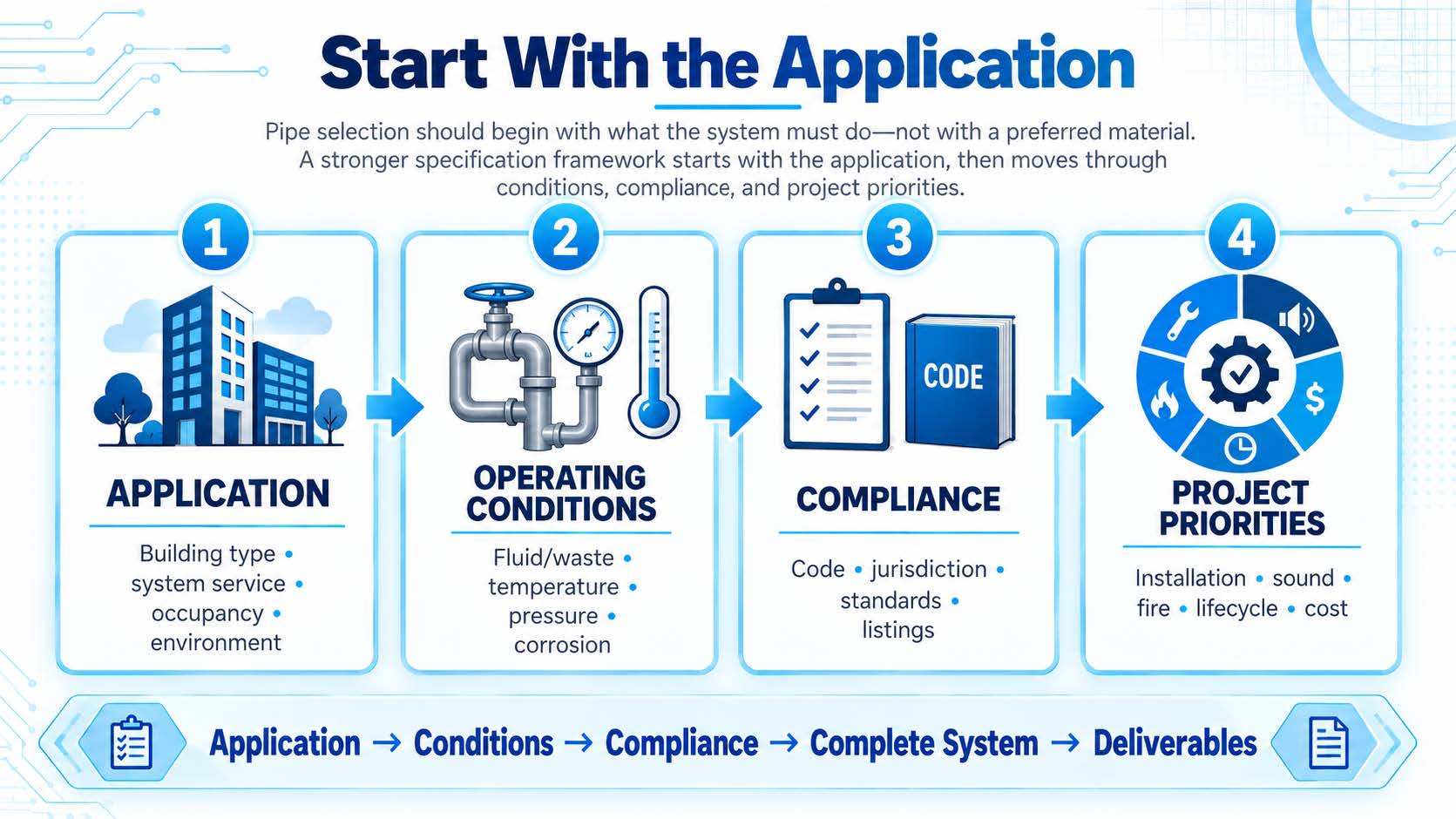
1. Start With the Application, Not the Material
Before asking, “What pipe should I use?”, engineers should consider what the system needs to accomplish.
A laboratory waste system has different requirements than domestic water distribution. A high-rise hotel may prioritize acoustic performance, while a commercial kitchen may require additional attention to temperature, chemical exposure and maintenance.
A practical selection process considers four factors.
These considerations establish the project’s requirements before a particular material or product is selected. The objective is not simply to find a suitable pipe. It is to develop a complete system that performs as intended throughout its service life.
2. Understanding Piping Materials and Their Applications
Different piping materials offer distinct advantages and limitations.
Selecting the appropriate system requires looking beyond material properties to understand how the complete installation will perform under actual project conditions.
Stainless Steel Drainage: Look Beyond Material Cost
Stainless-steel drainage systems can offer advantages where corrosion resistance, sanitation, durability and installation efficiency are important.
Depending on the selected system, push-fit connections may reduce joining labour and hot-work requirements compared with conventional methods.
However, a lower material price does not necessarily translate into a lower installed cost.
Engineers should consider the combined impact of joining methods, labour, supports, handling, maintenance and expected service life.
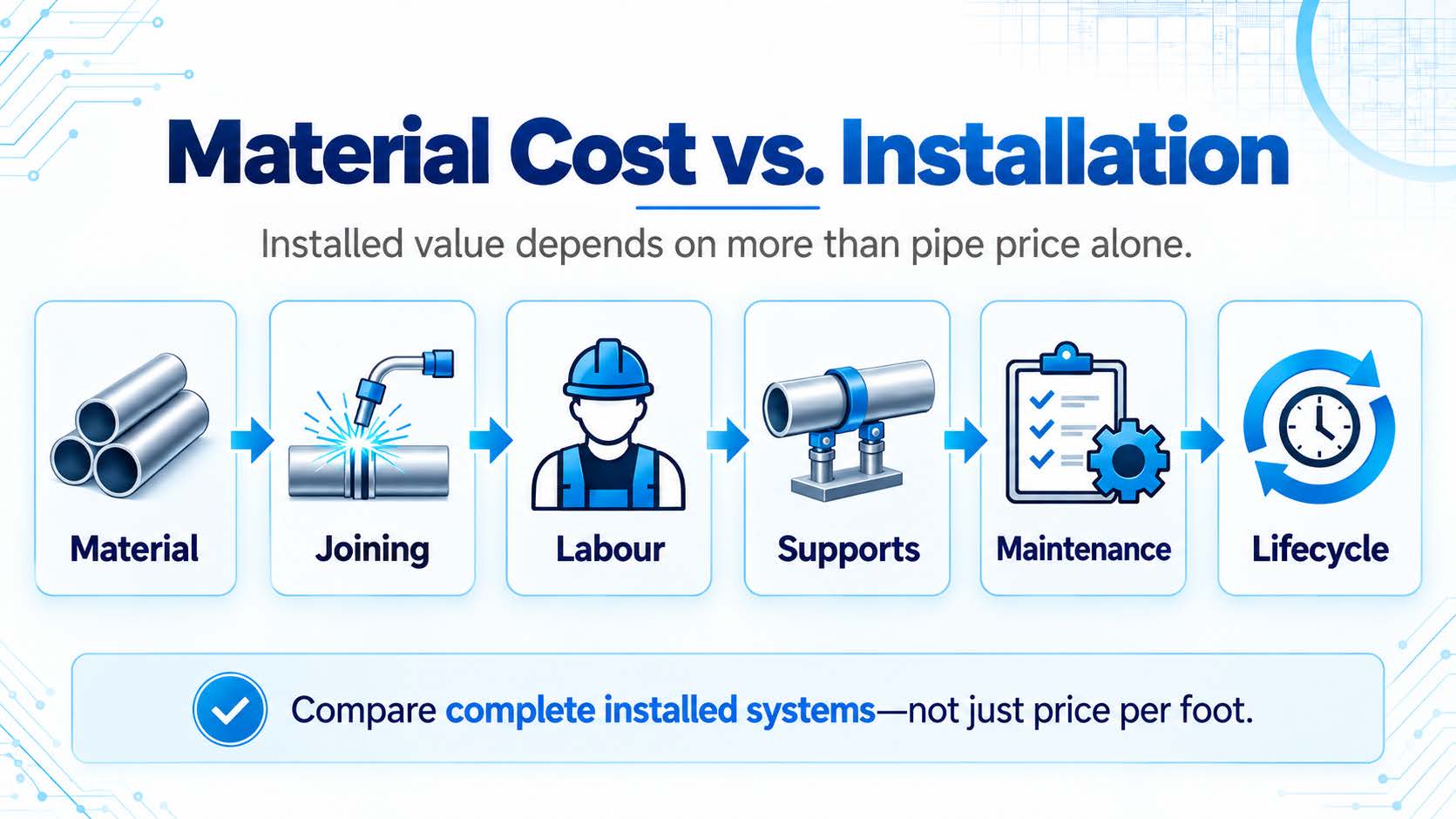
Specification takeaway: Evaluate the complete system, including pipe, fittings, seals, joining methods, supports and accessories, rather than material cost alone.
Corrosive Waste: Start With the Chemistry
Ordinary sanitary drainage assumptions cannot automatically be applied to laboratories, healthcare facilities or industrial systems carrying acids, alkalies and other aggressive substances.
Material compatibility depends on chemical composition, concentration, temperature and duration of exposure.
Specialty applications may require corrosion-resistant plastic piping, borosilicate glass or other materials suitable for the waste stream and permitted by the applicable jurisdiction.
But piping material is only one part of the design.
A complete system may also require neutralization tanks, treatment media, venting, interceptors, sampling, monitoring and controls.
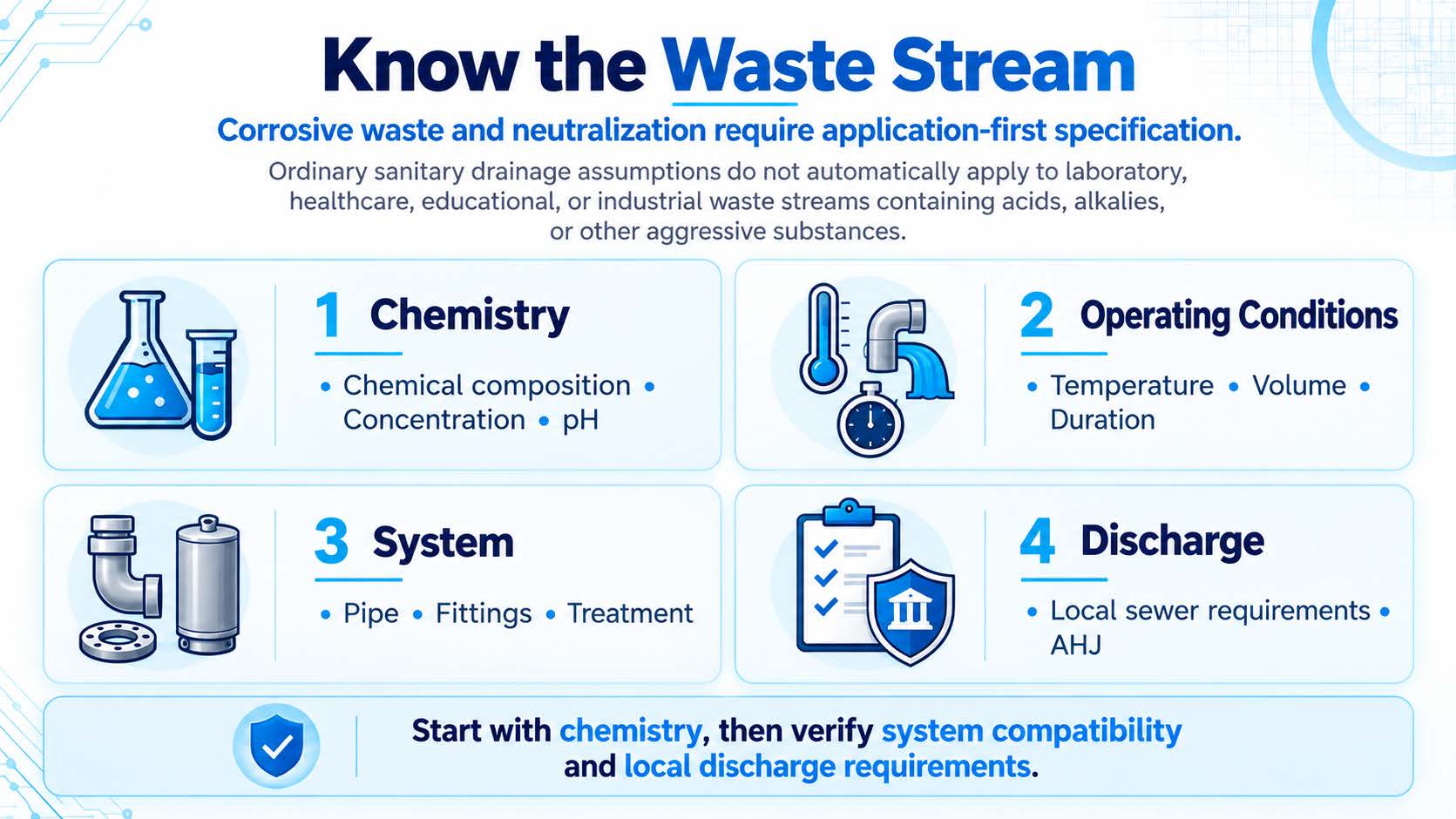
What must happen to the waste before it reaches the municipal system?
Municipal sewer-use bylaws may establish discharge limits independently of the building-code requirements governing the piping itself.
Engineers must therefore verify both material compatibility and discharge compliance.
Specification takeaway: Start with the waste chemistry, then coordinate the complete piping, treatment and discharge system. Dilution alone should not be assumed to satisfy applicable discharge requirements.
PEX: Specify the Complete Compatible System
PEX offers installation flexibility and can reduce the number of fittings required in certain hot- and cold-water distribution layouts.
However, not all PEX systems are identical.
Engineers must verify tubing classifications, compatible fittings, joining methods, pressure-temperature ratings, chlorine resistance, UV exposure, supports and installation requirements.
Relevant standards include:
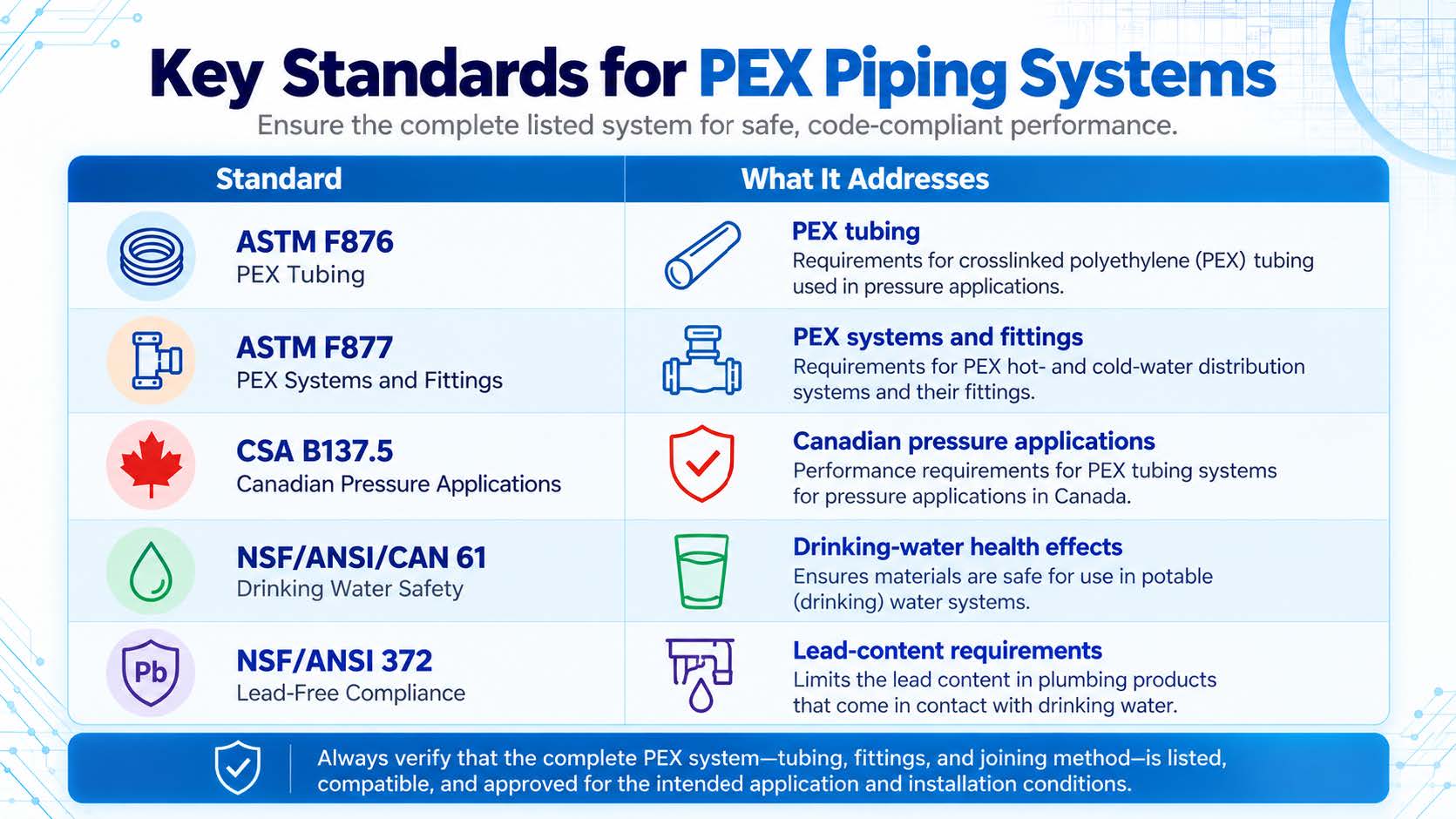
Confirm applicable standard editions, product certifications and jurisdictional requirements for each project.
Commercial installations can introduce additional requirements, particularly when piping passes through return-air plenums or other regulated spaces.
For example, an engineer specifying PEX in a return-air plenum may need to verify whether the selected product’s flame- and smoke-performance listing requires additional insulation or other installation conditions.
A compliant tubing product does not automatically make every proposed installation compliant.
Specification takeaway: Specify the complete compatible system, including tubing, fittings, joining methods, listings and installation requirements, not simply “PEX.”
Cast Iron: Performance Beyond the Base Material
Cast iron remains important in commercial drain, waste and vent (DWV) systems because of its rigidity, acoustic performance and non-combustibility.
However, aggressive waste conditions may require additional system protection.
For example, drainage from certain commercial kitchens or industrial processes may expose piping to conditions that warrant an enhanced coating system.
The engineer must consider the expected chemical exposure, coating compatibility, pipe and fitting construction, couplings and installation requirements together.
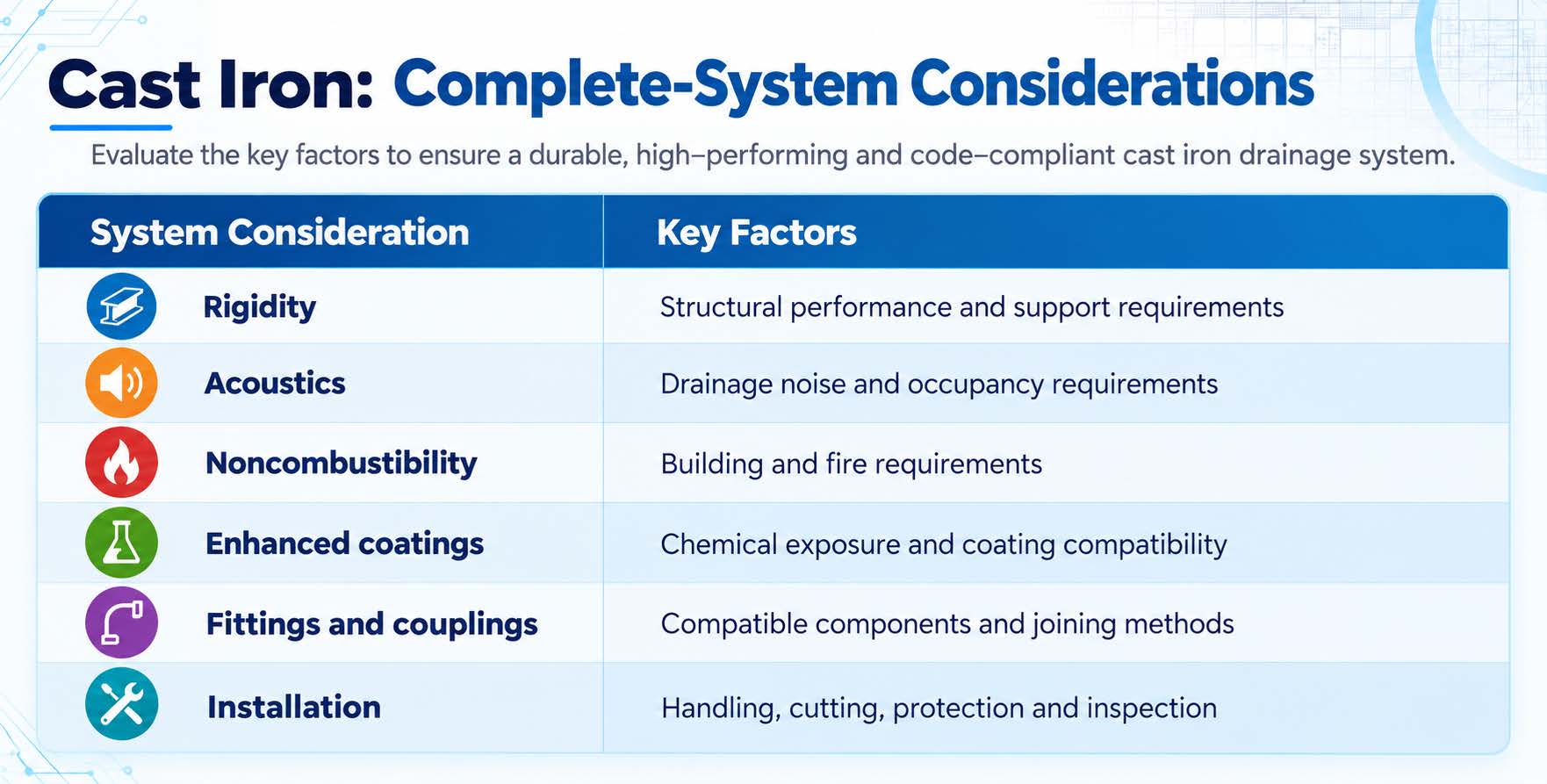
Rather than automatically specifying enhanced materials throughout a building, engineers can identify aggressive zones and evaluate specialized systems where project conditions warrant them.
Specification takeaway: The base material does not tell the entire performance story. Match the complete piping system to the application and expected exposure.
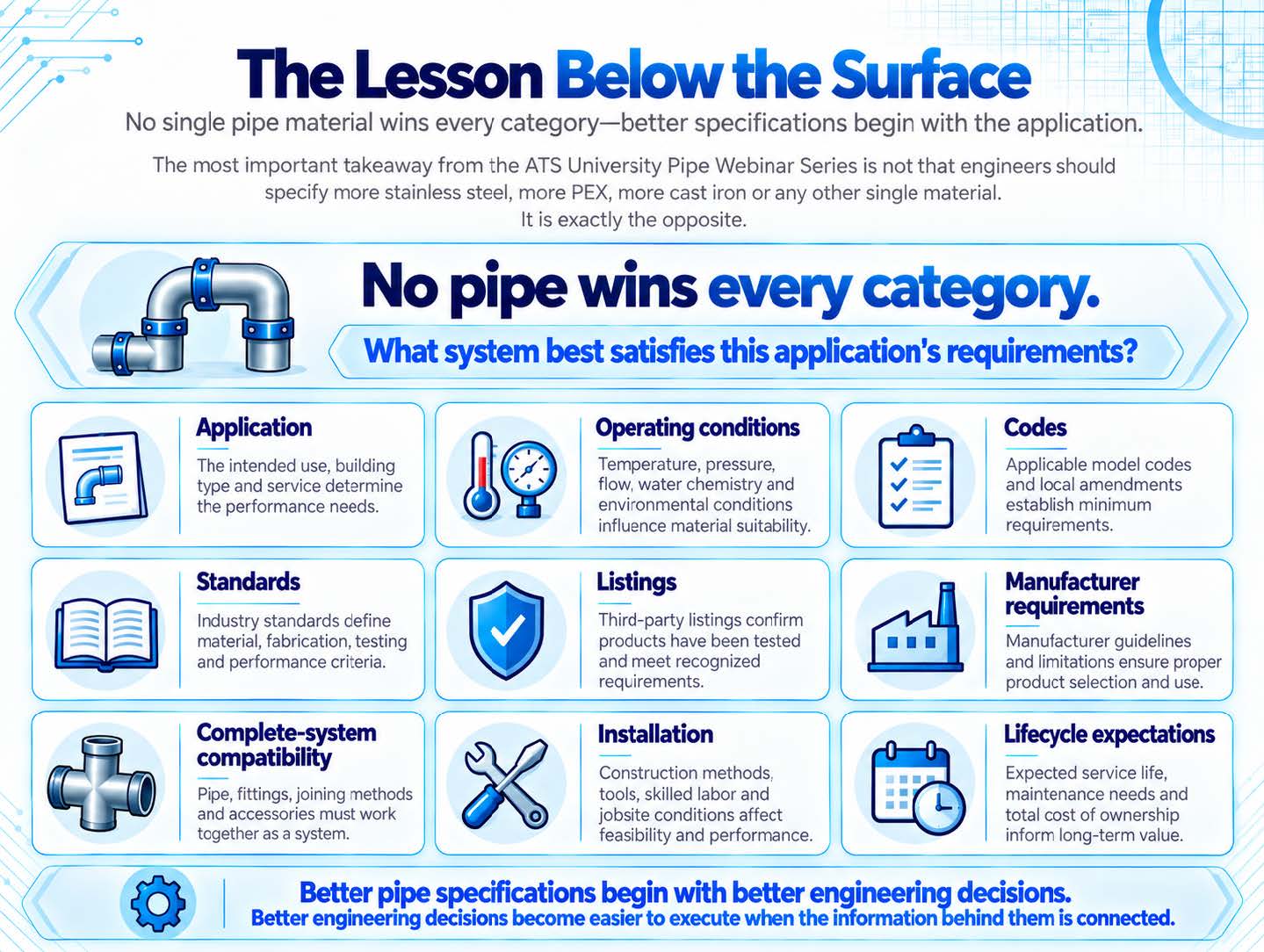
3. No Pipe Wins Every Category
Each piping material offers different characteristics and advantages.
Stainless steel, cast iron, PEX, PVC, ABS, copper and specialty glass must be evaluated against the operating conditions, applicable requirements and priorities of the individual project.
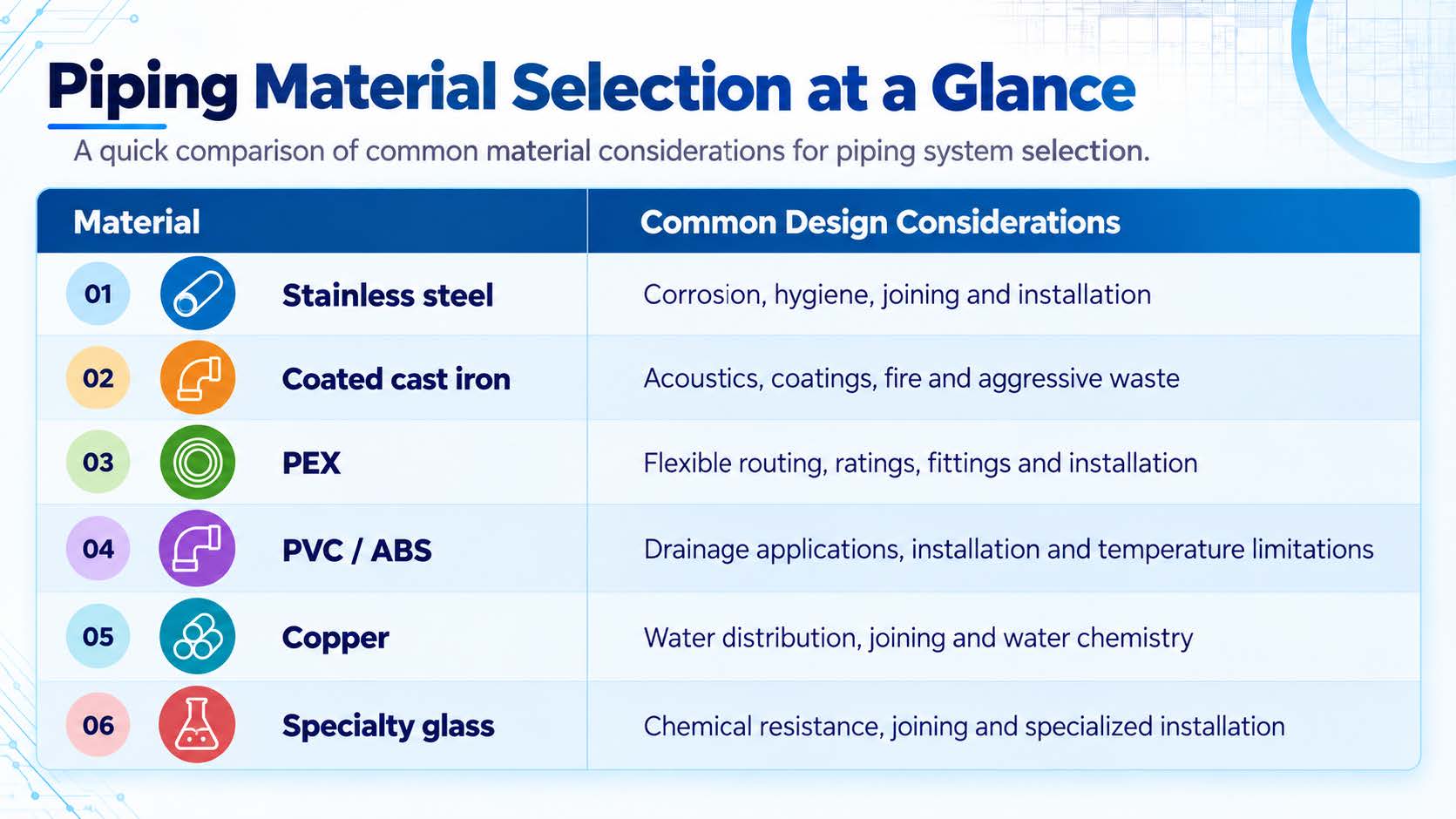
Material suitability depends on the specific product, application and project requirements. This table is not a universal performance ranking.
The same material can also vary considerably between manufacturers, product lines and system configurations.
Final selection must be verified against the applicable code, referenced standards, product listings, manufacturer documentation, fluid compatibility and project conditions.
The right material is the one that satisfies the application—not simply the one with the most familiar name or lowest initial price.
4. Codes, Standards and Listings Are Not the Same Thing
A piping material may meet a recognized product standard but still be unsuitable for a particular installation.
Understanding the differences between codes, standards, listings and manufacturer requirements helps engineers coordinate a compliant and complete system.
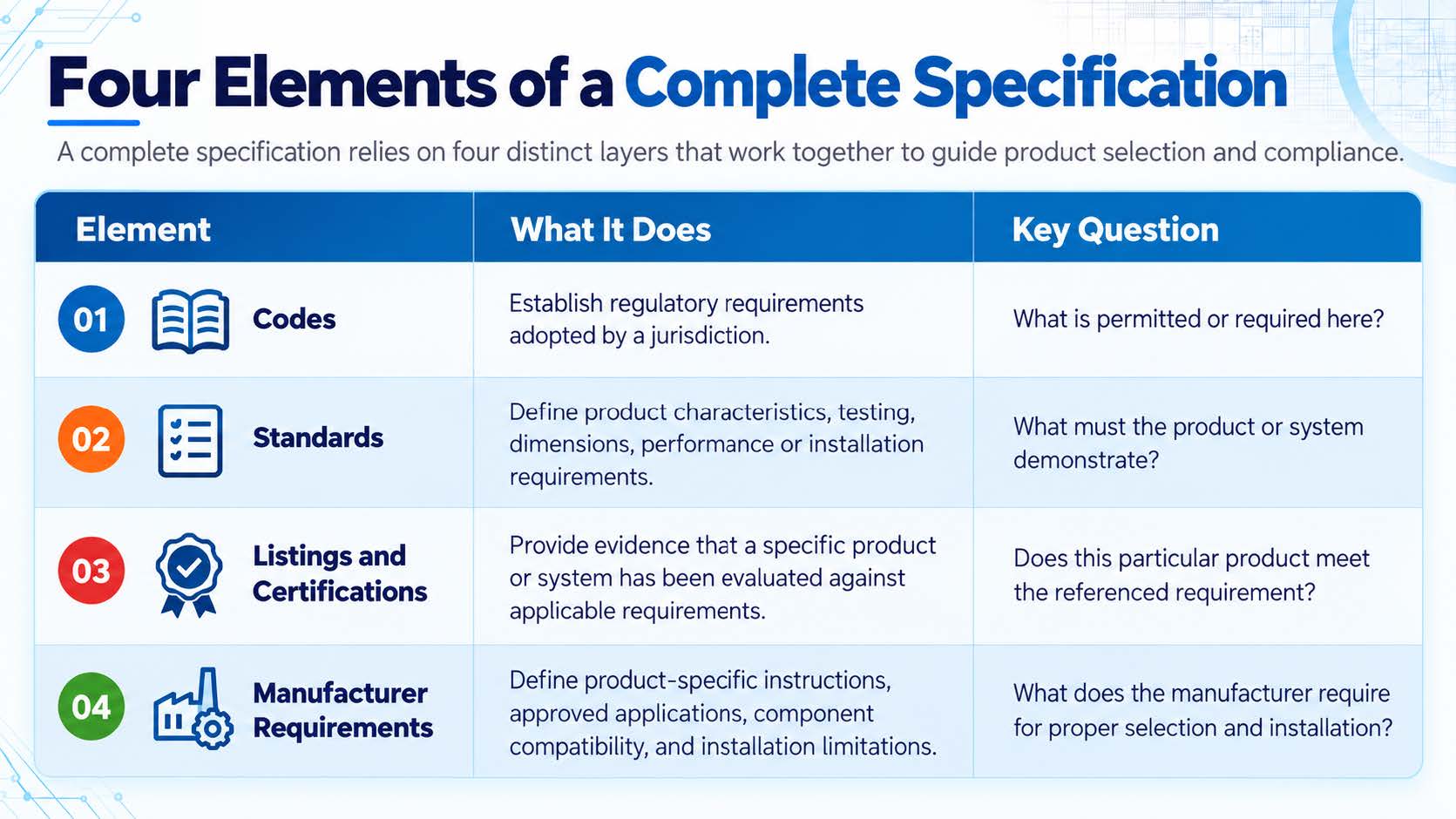
Define product-specific configurations, operating limits, compatible components and installation conditions.
How must the product be selected, configured and installed?
Consider a PEX tubing product that meets an applicable material standard.
The engineer must still confirm that the selected fittings and joining methods are compatible, the product has the required listings, and the installation conditions meet the project’s applicable requirements.
The same principle applies to other piping systems.
The correct material does not automatically produce the correct system.
5. The Modern Specification Challenge: More Information, More Coordination
Mechanical engineers have access to more product information than ever before.
But more information does not necessarily make specification easier.
Building codes, standards, manufacturer websites, product catalogs, technical data sheets, BIM libraries, office masters and previous project documents may all contain information needed to complete a single specification.
The challenge is keeping that information current, compatible and coordinated.
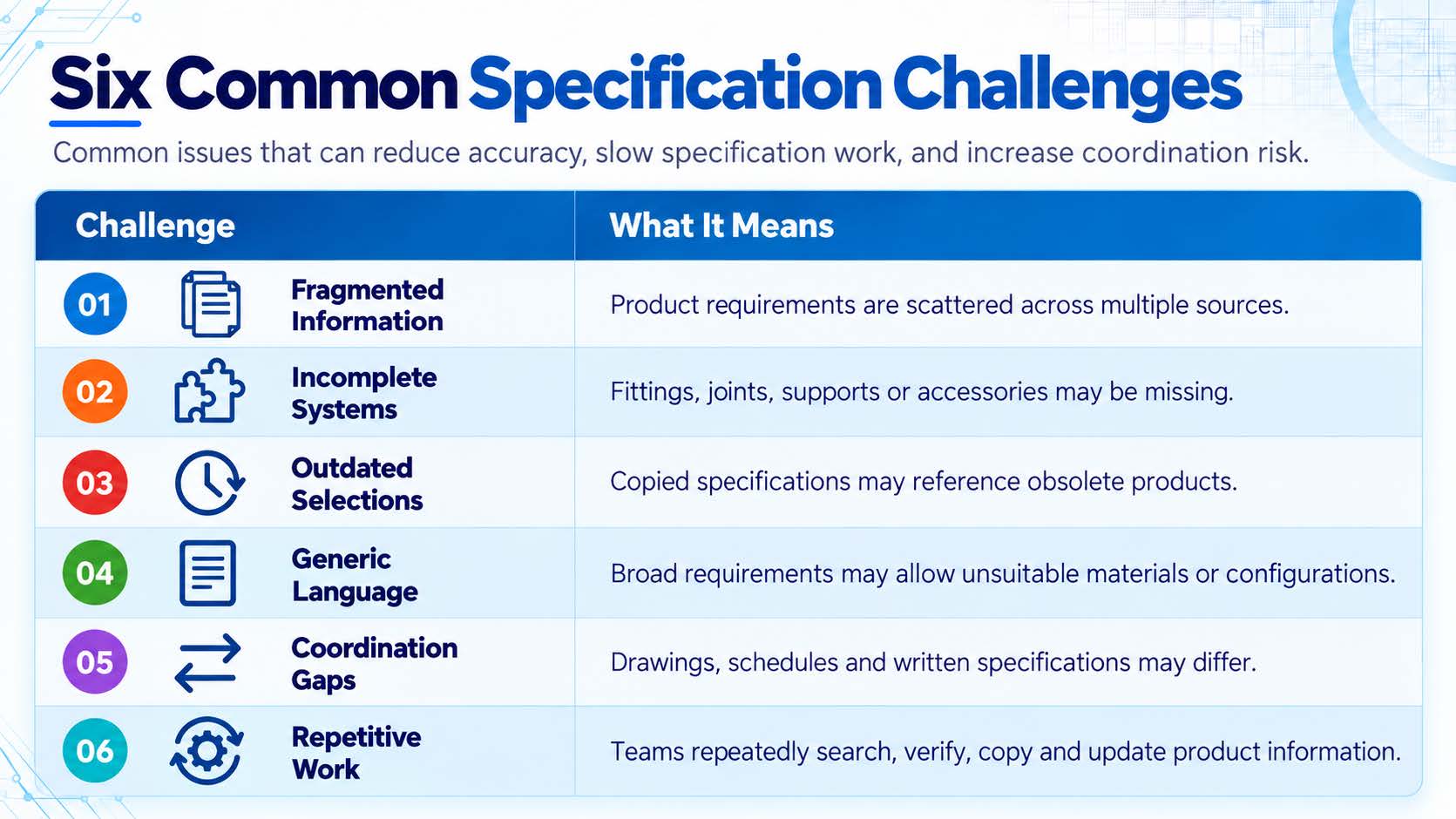
These challenges can become more significant as project complexity increases and multiple engineers contribute to the same specification package.
For example, an office master may reference a previously selected product, while updated manufacturer data identifies a different fitting requirement or product configuration.
Without a coordinated process, inconsistencies may carry forward into project schedules, specifications and supporting documentation.
The real challenge is no longer simply finding a pipe.
It is maintaining a coordinated specification from design intent through project documentation.
6. Five Rules for Better Pipe Specifications
A practical specification framework can help engineers manage these challenges across different materials and applications.
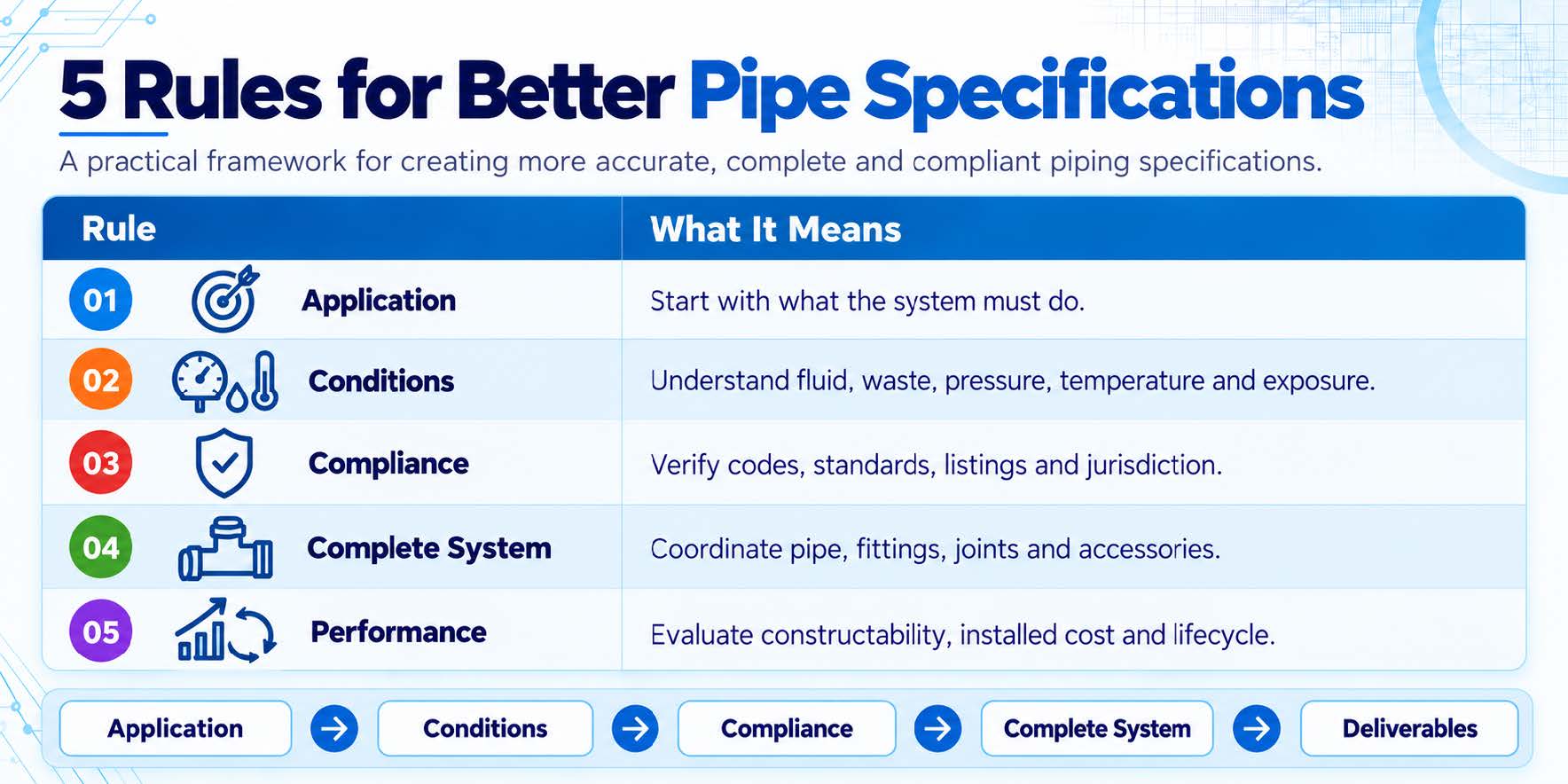
Applying these principles helps engineers move beyond individual product selections toward complete, project-specific piping specifications.
The next step is making those decisions easier to organize and maintain throughout the project.
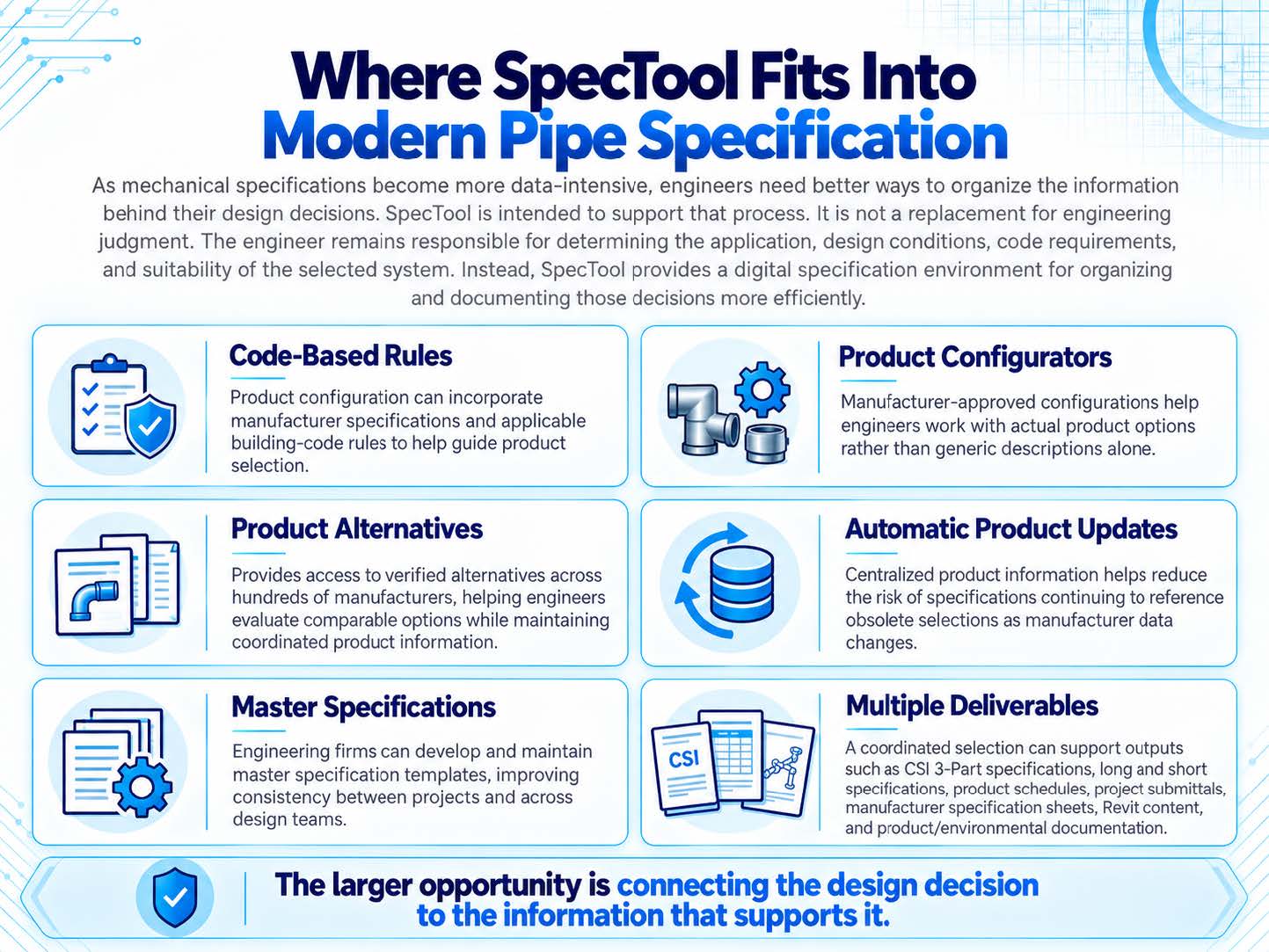
7. From Engineering Decisions to Complete Specifications: Where SpecTool Fits
As mechanical specifications become more data-intensive, engineers also need better ways to organize the information behind their design decisions.
That is the role ATS SpecTool is intended to support. SpecTool is not a replacement for engineering judgment. The engineer remains responsible for determining the application, design conditions, code requirements and suitability of the selected system.
Instead, SpecTool provides a digital specification environment for organizing and documenting those decisions more efficiently.
Key Takeaways
Practical lessons for creating stronger, more coordinated piping specifications.
- Start with the application, not a preferred material.
- Treat pipe, fittings, joints & accessories as one system
- Distinguish between codes, standards, listings & manufacturer requirements.
- Evaluate total installed value rather than material cost alone.
- Verify chemical & operating compatibility for specialty waste systems.
- Keep specification information current & coordinated across project deliverables.
- Use digital tools to support engineering judgment, not to replace it.
The goal is not faster documents alone, it is better connected engineering information.
Build Your Next Pipe Specification in SpecTool
From pipe and fitting selection to standards-based filtering, product alternatives, project schedules and complete specification outputs, ATS SpecTool helps mechanical engineers move from design decision to coordinated project documentation in one specification environment.
Create your free SpecTool account and start building your next piping specification.
Also explore the full ATS University Pipe Webinar Series to go deeper into:
- Push-Fit Stainless Steel Drainage with BLÜCHER / Watts
- Corrosive Waste Design, Compliance & Neutralization with SMS
- PEX Applicable Codes & Standards with RWC
- Cast Iron Coatings for Aggressive DWV Applications with Charlotte Pipe
- Below the Surface: Cracking the Code on Commercial & Residential Piping with ATS Software
Share this article
